Straddle carriers transfer containers between storage yards and trucks by driving over the container, lifting it with a hydraulically operated or electrically driven spreader, and transporting it while the container remains suspended between the carrier’s wheels. At the truck interface, the carrier positions the container above the chassis, lowers it onto the twist-lock fittings, and releases the load after confirming that it is properly seated. The same process works in reverse when unloading containers from trucks into the yard.
This operating method allows a straddle carrier crane to perform both container lifting and horizontal transportation without relying on separate yard cranes and terminal tractors for every transfer. It is particularly useful in container terminals, intermodal yards, inland depots, and industrial logistics facilities where flexible container handling and efficient truck turnaround are important.
1. What Is a Straddle Carrier in Container Handling?
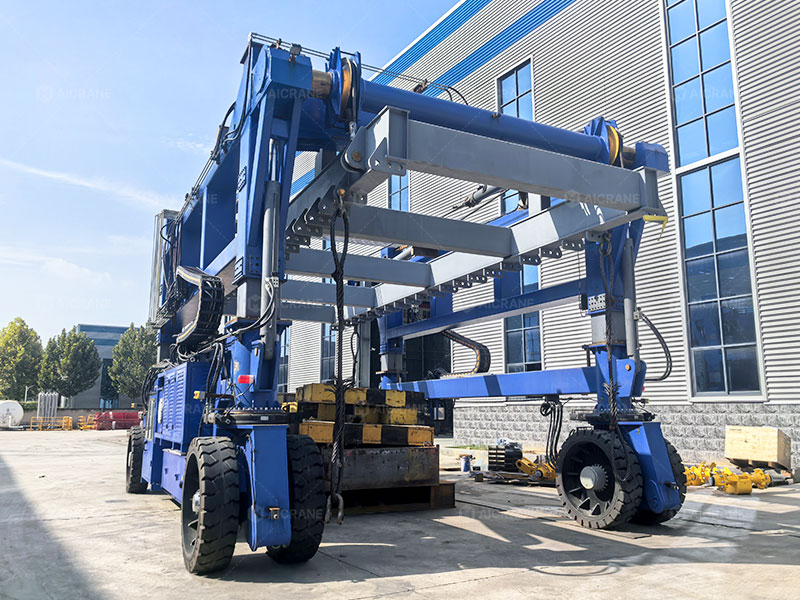
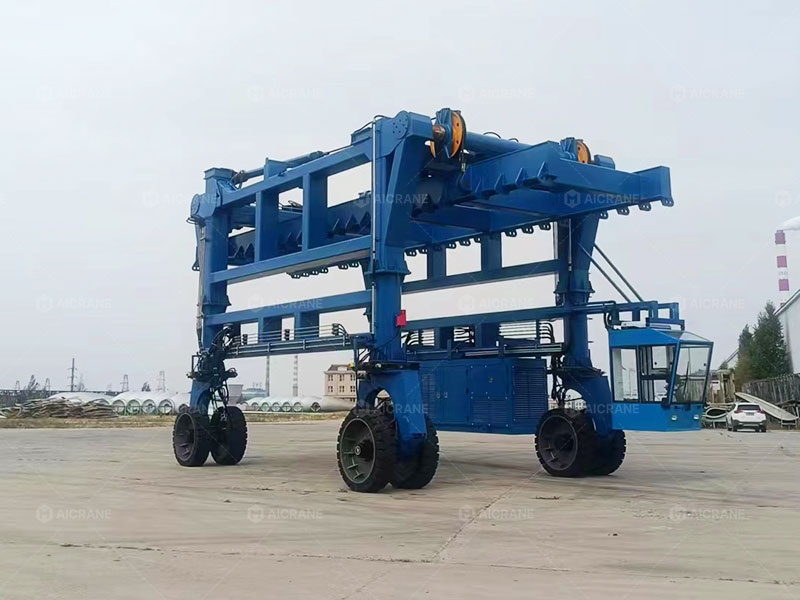
A straddle carrier is a mobile container handling machine designed to lift and transport containers by straddling them. Its tall portal-shaped frame provides enough clearance for the machine to travel over a container, while its lifting system raises the container above the ground and carries it between the wheels.
Unlike a reach stacker, which lifts containers from one side using a telescopic boom, a straddle carrier lifts containers from above using a spreader. This arrangement allows the carrier to transport containers directly through the yard without requiring a separate lifting machine at every transfer point.
The main components involved in container transfer include:
-
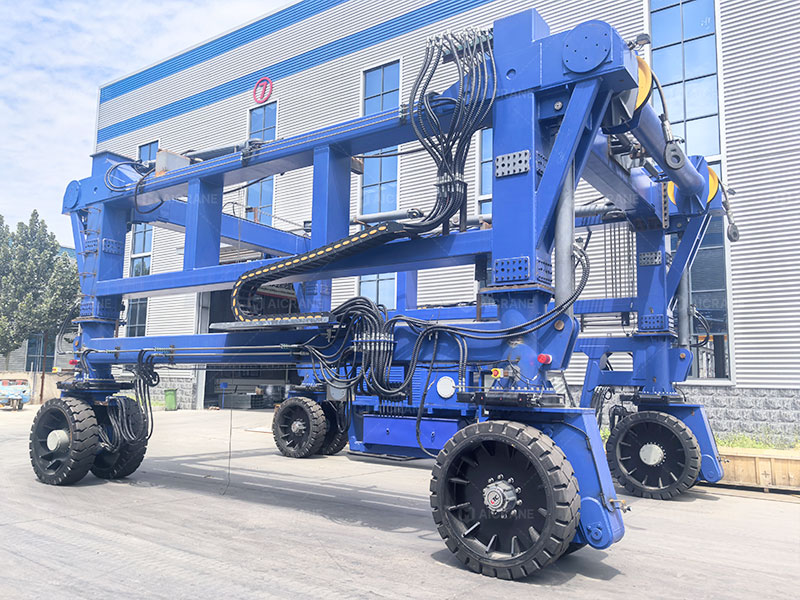
Portal frame: Supports the lifting system and provides clearance for containers.
-
Spreader: Connects to the container’s corner castings through twist locks.
-
Hoisting system: Raises and lowers the container using wire ropes, hydraulic cylinders, or another model-specific lifting arrangement.
-
Travel drive: Moves the carrier between the yard and truck interchange area.
-
Steering system: Allows the carrier to maneuver through designated yard lanes.
-
Control system: Coordinates lifting, lowering, traveling, steering, and safety functions.
The specific configuration depends on the manufacturer’s design, rated capacity, container dimensions, and operating requirements.
2. How Does a Straddle Carrier Transfer Containers from the Yard to Trucks?
The transfer process generally involves five stages: container pickup, lifting, transportation, positioning, and placement on the truck chassis.
The straddle carrier first travels to the container’s designated storage position.
The operator aligns the machine with the container so that the spreader is directly above its four upper corner castings. Accurate positioning is essential because the spreader’s twist locks must engage correctly with the container.
Depending on the equipment configuration, positioning assistance may include:
-
Camera systems.
-
Spreader alignment indicators.
-
Container identification systems.
-
Laser or sensor-based positioning assistance.
-
Operator-controlled manual alignment.
Before lifting, the operator must also confirm that the container is suitable for handling and that the lifting area is clear.
Step 2: Connecting the Spreader to the Container
Once the carrier is correctly positioned, the spreader is lowered onto the container.
The spreader’s twist locks enter the corresponding corner castings. After alignment, the twist locks rotate to secure the connection.
A typical container spreader is designed around standardized ISO container corner fittings. Depending on the carrier model, it may handle 20-foot, 40-foot, or 45-foot containers.
Some configurations use telescopic spreaders that adjust to different container lengths. Others use fixed-length or specialized spreaders.
The operator or control system confirms that the twist locks are properly engaged before lifting begins.
Step 3: Lifting the Container
After the spreader is locked, the hoisting system raises the container.
The container is lifted high enough to provide safe clearance above the ground, yard surface, or other obstacles along the travel route.
During lifting, the operator must consider:
-
Container gross weight.
-
Rated lifting capacity.
-
Load distribution.
-
Spreader engagement.
-
Lifting height.
-
Container swing and stability.
The rated capacity of a straddle carrier varies by model and lifting configuration. Buyers should distinguish between the maximum rated capacity and the actual allowable load under the intended operating conditions.
Step 4: Transporting the Container to the Truck Area
With the container suspended between its wheels, the straddle carrier travels toward the truck interchange area.
This is one of the main advantages of the equipment. The same machine performs both lifting and transportation, reducing the need to transfer the container between multiple handling machines.
During transportation, the carrier must maintain appropriate clearance and travel speed. Acceleration, braking, steering, and load movement all affect operational stability.
The yard layout should provide sufficient space for:
-
Straight-line travel.
-
Turning and lane changes.
-
Truck positioning.
-
Pedestrian and vehicle separation.
-
Safe access to container storage blocks.
The carrier normally follows designated travel routes rather than moving freely through areas occupied by other equipment.
Step 5: Lowering the Container onto the Truck Chassis
At the truck interchange area, the carrier aligns the suspended container with the truck chassis.
The operator carefully lowers the container until its bottom corner castings are seated on the chassis fittings. The container’s position must match the chassis configuration, including its length and twist-lock locations.
Once the container is properly supported, the spreader twist locks are released.
The straddle carrier then raises its spreader slightly, confirms that it is clear of the container, and moves away from the truck.
The truck can proceed to the next stage of transportation after the driver or designated personnel complete the required securing and departure checks.
3. How Does the Reverse Process Work When Trucks Deliver Containers to the Yard?
When a loaded or empty container arrives by truck, the straddle carrier performs the reverse operation.
-
Truck positioning: The truck enters the designated interchange area and stops at the assigned transfer position.
-
Spreader alignment: The straddle carrier moves above the truck chassis and aligns its spreader with the container.
-
Twist-lock engagement: The spreader locks onto the container’s upper corner castings.
-
Container lifting: The hoisting system raises the container clear of the truck chassis.
-
Truck clearance: The truck can leave the interchange area once the transfer and applicable safety checks are complete.
-
Yard transportation: The carrier transports the container to its assigned storage location.
-
Container placement: The carrier lowers the container onto the designated ground position or stack and releases the spreader.
The reverse process requires accurate coordination between the truck driver, straddle carrier operator, and yard management system.
A well-organized interchange area helps prevent unnecessary truck waiting time and reduces conflicts between incoming and outgoing vehicles.
4. How Does a Straddle Carrier Stack Containers in the Yard?
Straddle carriers do more than transfer containers between trucks and storage areas. Many models can also stack containers vertically.
The stacking arrangement depends on the machine’s rated lifting capacity, lifting height, container weight, and yard configuration.
Common operating arrangements include:
-
Ground-level container placement.
-
Two-high stacking.
-
Three-high stacking.
-
Higher stacking configurations on models specifically designed and rated for them.
Not every straddle carrier has the same stacking capability. Buyers should verify the manufacturer’s rated stacking height and allowable load at each lifting level.
For example, a carrier designed to handle heavier containers at ground level may have a different allowable capacity when placing containers at the top of a stack.
This distinction is important when planning yard capacity. The number of containers that can be stored in a given area depends not only on stacking height but also on access lanes, container retrieval requirements, and the equipment’s maneuvering space.
5. What Makes Straddle Carriers Suitable for Yard-to-Truck Transfers?
Straddle carriers are particularly useful when container terminals need one machine to handle both vertical lifting and horizontal movement.
Several operational characteristics explain their suitability.
Integrated Lifting and Transportation
A straddle carrier combines container lifting and transportation in one machine.
In a conventional handling arrangement, a yard container gantry crane may lift containers while terminal tractors move them between storage areas and truck interchange points.
A straddle carrier can perform both functions, potentially reducing the number of separate handling steps.
However, this does not mean it always replaces every other terminal machine. Large terminals may use a combination of straddle carriers, yard cranes, terminal tractors, and other equipment depending on throughput and layout.
Flexible Movement Between Yard Blocks
Straddle carriers can move between designated container handling areas without depending on fixed rails or a dedicated lifting runway.
This provides flexibility when yard operations change, storage blocks are reorganized, or containers need to be transferred between different operating zones.
The actual maneuverability depends on the steering configuration, wheel arrangement, turning radius, and available yard space.
Reduced Dependence on Separate Transfer Equipment
Because the carrier can lift a container directly from a truck and transport it to the yard, the terminal may reduce its dependence on separate equipment for certain transfer operations.
This can simplify the equipment workflow, particularly in small and medium-sized container yards.
Nevertheless, the overall equipment requirement should be evaluated against the terminal’s peak container throughput, traffic pattern, and equipment availability.
Direct Access to Truck Chassis
The portal-frame structure allows the carrier to move over a truck and position its spreader above the container.
This makes direct truck loading and unloading possible without requiring a separate crane positioned beside the truck.
The truck interchange area must still be designed with adequate height clearance, access space, and safe vehicle positioning.
6. What Specifications Matter When Selecting a Straddle Carrier for Truck Transfers?
Selecting a straddle carrier requires more than checking its maximum lifting capacity. Buyers should evaluate the container types, yard arrangement, transfer frequency, and operating environment.
| Selection Factor | What Buyers Should Check | Operational Importance |
|---|---|---|
| Lifting capacity | Rated container weight | Determines the maximum allowable handling load |
| Container compatibility | 20 ft, 40 ft, 45 ft | Ensures compatibility with the terminal’s container fleet |
| Lifting height | Ground-level and stacking requirements | Determines stacking capability |
| Travel speed | Loaded and unloaded speeds | Affects transfer cycle time |
| Steering system | Straight, diagonal, or other available modes | Influences maneuverability |
| Power system | Diesel, electric, or battery-powered configuration | Affects energy use and operating requirements |
| Yard dimensions | Lane width and turning space | Determines whether the machine can operate efficiently |
| Safety systems | Cameras, alarms, sensors, and interlocks | Supports safe handling and vehicle coordination |
Lifting Capacity and Container Weight
The rated lifting capacity must cover the maximum container gross weight expected in daily operations.
For example, a terminal regularly handling fully loaded 40-foot containers should not select equipment based only on the average weight of its containers.
The buyer should also confirm the rated capacity at the required lifting height and under the intended operating configuration.
Container Length and Spreader Configuration
Container length affects spreader selection.
A terminal handling both 20-foot and 40-foot containers may require a telescopic spreader or another compatible configuration.
If the facility also handles 45-foot containers, this requirement should be specified before equipment procurement.
Travel Speed and Transfer Cycle
Travel speed influences how quickly the carrier can move containers between the storage yard and truck interchange area.
However, maximum travel speed alone does not determine productivity.
The complete transfer cycle includes:
-
Positioning above the container.
-
Spreader engagement.
-
Hoisting.
-
Loaded travel.
-
Truck alignment.
-
Lowering and releasing.
-
Returning to the next operating position.
A machine with a high maximum speed may not deliver better overall productivity if the yard layout requires frequent turning or precise positioning.
7. How Do Yard Layout and Truck Positioning Affect Transfer Efficiency?
The physical arrangement of the container yard has a direct effect on straddle carrier performance.
A poorly designed layout can increase travel distances, create traffic conflicts, and reduce the number of transfers completed per operating shift.
Three layout factors are particularly important.
Truck interchange location: Truck transfer points should be positioned to minimize unnecessary travel between storage blocks and truck access areas.
Travel lane width: The yard must provide sufficient space for the carrier’s overall dimensions, steering movements, and safe clearance from adjacent equipment.
Container storage arrangement: Storage blocks should allow the carrier to access containers without excessive repositioning or interference from other handling operations.
For example, a depot that frequently transfers containers between trucks and nearby storage blocks may benefit from relatively short, direct travel routes.
A larger intermodal terminal with several storage zones may require a more structured yard traffic plan, including designated routes and separate truck interchange areas.
Truck positioning is equally important. Vehicles should stop at clearly marked transfer points with the chassis correctly aligned. Poor alignment can increase spreader positioning time and complicate container placement.
8. What Safety Considerations Apply During Straddle Carrier Container Transfers?
Straddle carrier operations involve suspended loads, moving heavy machinery, and interactions with trucks and pedestrians. Safety procedures must therefore cover the entire transfer cycle.
Important considerations include:
Load Security
The spreader must be correctly engaged with all required container corner castings before lifting.
Operators should verify twist-lock status and follow the equipment manufacturer’s procedures for load handling.
Truck and Carrier Coordination
The truck should remain stationary during container lifting and placement.
Clear communication between the carrier operator and truck driver is essential. The truck should not move until the container has been safely transferred and the relevant release procedure has been completed.
Load Stability
Operators should avoid sudden acceleration, braking, and sharp steering movements while transporting suspended containers.
Travel speeds should be appropriate for the load, road conditions, and operating environment.
Yard Traffic Management
Pedestrian access should be controlled around active lifting and travel zones.
Facilities should establish designated travel lanes, warning systems, traffic rules, and exclusion zones to reduce the risk of collisions.
Equipment Inspection
Regular inspection should cover:
-
Spreader structure and twist locks.
-
Hoisting ropes or lifting components.
-
Hydraulic systems.
-
Braking systems.
-
Steering and tires.
-
Electrical systems and control devices.
-
Cameras, sensors, and warning alarms.
Inspection intervals and maintenance procedures should follow the gantry crane manufacturer‘s instructions and applicable local regulations.
9. Straddle Carrier vs. Reach Stacker: Which Is Better for Yard-to-Truck Transfers?
Both straddle carriers and reach stackers can transfer containers between storage yards and trucks, but their lifting structures and operating methods are different.
| Comparison Factor | Straddle Carrier | Reach Stacker |
|---|---|---|
| Lifting method | Overhead spreader | Telescopic boom and spreader |
| Container positioning | Machine drives over the container | Machine approaches from the side |
| Transportation | Carries container between its wheels | Carries container in front of the machine |
| Stacking | Designed for vertical container stacking | Can stack containers depending on model |
| Yard arrangement | Requires suitable travel lanes and overhead clearance | Requires operating and stacking clearance |
| Truck transfer | Direct overhead lifting | Direct boom-based lifting |
| Typical application | Container terminals, depots, and intermodal yards | Container depots, logistics yards, and smaller handling operations |
A straddle carrier is often suitable for operations requiring repeated container transportation between storage blocks and truck interchange points.
A reach stacker may be more appropriate for facilities that need flexible side access, relatively low handling volumes, or a machine that can perform different container handling tasks within a compact operating area.
The better choice depends on container throughput, stacking requirements, available space, operating costs, and the facility’s overall handling workflow.
10. How Can Straddle Carrier Operations Reduce Truck Turnaround Time?
Truck turnaround time refers to the total time a truck spends inside a terminal or depot, from arrival to departure.
Straddle carriers can support shorter turnaround times by combining container pickup and transportation in one machine.
However, actual performance depends on more than the equipment itself.
The following operational measures can improve transfer efficiency:
-
Pre-assign container locations: Use a yard management system to identify where incoming or outgoing containers are stored.
-
Schedule truck arrivals: Reduce congestion by coordinating truck appointments and expected handling demand.
-
Prepare the interchange area: Keep transfer positions clear and ensure chassis alignment.
-
Optimize travel routes: Minimize unnecessary movement between yard blocks and truck transfer areas.
-
Monitor equipment availability: Schedule preventive maintenance to reduce unexpected downtime.
-
Coordinate handling activities: Ensure the carrier operator and truck driver follow a consistent transfer procedure.
For example, if a truck arrives to collect a container that has already been assigned a storage location, the terminal can prepare the transfer before the vehicle reaches the interchange area.
This reduces unnecessary searching and helps the carrier complete the handling cycle more efficiently.
11. What Should Buyers Consider Before Purchasing a Straddle Carrier?
Industrial buyers should evaluate the equipment based on the actual container handling workflow rather than selecting a machine solely by capacity or advertised travel speed.
Before requesting a quotation, buyers should prepare the following information:
-
Container types: Specify whether the facility handles 20-foot, 40-foot, or 45-foot containers.
-
Maximum container weight: Provide the maximum gross weight of loaded containers.
-
Stacking requirements: Define the required number of stacking levels and lifting height.
-
Daily handling volume: Estimate the number of container transfers per shift or per day.
-
Yard dimensions: Provide travel lane widths, storage block dimensions, and turning requirements.
-
Truck configuration: Identify the chassis types and container lengths used by incoming and outgoing trucks.
-
Operating conditions: Specify ground conditions, gradients, temperature, rainfall, and other environmental factors.
-
Power requirements: Evaluate diesel, electric, or battery-powered configurations based on operating hours and available infrastructure.
-
Safety requirements: Identify applicable standards and required operator assistance systems.
-
Maintenance support: Confirm spare parts availability, service arrangements, and technical support.
A detailed operating profile helps the manufacturer determine the appropriate carrier configuration, spreader type, lifting capacity, steering system, and power arrangement.
For terminals planning future expansion, it is also important to consider whether the selected machine can support increased container volumes and changes in yard organization.
12. Frequently Asked Questions About Straddle Carrier Container Transfers
Can a straddle carrier load containers directly onto trucks?
Yes. An AICRANE straddle carrier can drive over a truck chassis, lower its spreader onto the container, lift the container, and place it directly onto the chassis. It can also perform the reverse operation to unload containers from trucks.
Does a straddle carrier need a separate crane to transfer containers?
No. A straddle carrier has its own overhead lifting system and can independently pick up and transport containers within its rated operating capacity. However, larger terminals may still use additional cranes or handling equipment to meet throughput requirements.
Can a straddle carrier handle both 20-foot and 40-foot containers?
Yes, provided that its spreader configuration supports the required container lengths. Telescopic spreaders are commonly used when multiple container sizes must be handled by one machine. Buyers should confirm compatibility with the manufacturer’s specifications.
How many containers can a straddle carrier stack?
The stacking height depends on the specific model, rated lifting capacity, container weight, and operating configuration. Some machines are designed for two-high or three-high stacking, while other configurations may support different arrangements. The manufacturer’s rated stacking specifications should always be checked.
Is a straddle carrier suitable for small container yards?
It can be suitable for small and medium-sized container yards, particularly when the facility needs one machine to perform both lifting and transportation. However, buyers should compare its investment cost, operating space, maintenance requirements, and handling capacity with alternative equipment.
What is the difference between a straddle carrier and a terminal tractor?
A straddle carrier can lift, transport, and stack containers using its integrated lifting system. A terminal tractor primarily moves container chassis or trailers and generally requires a separate crane or lifting machine to load and unload containers.
Conclusion
Straddle carriers transfer containers between yards and trucks through an integrated process of overhead lifting, horizontal transportation, and precise container placement. Their ability to perform both lifting and transportation makes them a practical option for container terminals, inland depots, and intermodal facilities that require flexible container handling.
For buyers evaluating a straddle carrier, the most important considerations are rated lifting capacity, container compatibility, stacking height, travel and steering performance, yard layout, and truck interchange requirements.
The right equipment configuration should match the facility’s actual container flow, rather than relying on a single specification such as maximum lifting capacity or travel speed. A properly selected straddle carrier can help simplify handling workflows, improve yard flexibility, and support efficient truck loading and unloading operations.