Choosing between a 50 ton gantry crane and a 60 ton gantry crane should not be based only on the heaviest load currently handled. The correct capacity depends on the actual lifted load, lifting accessories, load distribution, duty cycle, lifting height, span, operating conditions, and expected future requirements. A 50 ton crane may be sufficient when the maximum planned lifted load remains comfortably below its rated capacity and operating conditions are well controlled. A 60 ton gantry crane can provide additional working capacity when loads approach 50 tons, lifting accessories add significant weight, or future loads may increase. However, the higher-rated crane also affects structural design, supporting foundations, travel systems, power requirements, and purchase cost. The key is to select the lowest rated capacity that safely covers the required lifting envelope without creating unnecessary equipment and infrastructure costs.
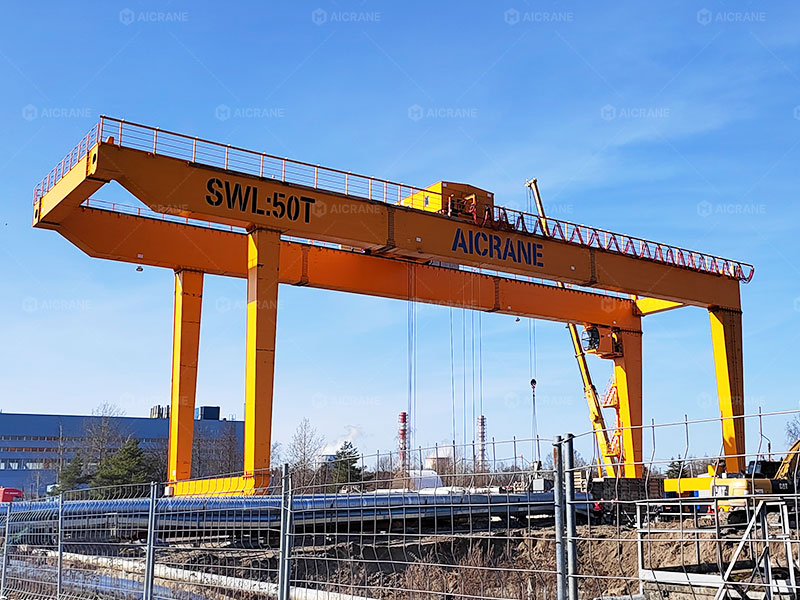
What Is the Difference Between a 50 Ton and 60 Ton Gantry Crane?
The primary difference is the rated lifting capacity.
A 50 ton gantry crane is designed for a maximum rated lifted load of 50 metric tons or another specified capacity basis defined by the manufacturer and applicable design standard. A 60 ton gantry crane is rated for up to 60 tons under its specified operating conditions.
That 10 ton difference represents a 20% increase in rated capacity:
- 50 ton crane: 50 ton rated capacity
- 60 ton crane: 60 ton rated capacity
- Capacity difference: 10 tons
- Relative increase: 20%
However, this does not mean that every component of a 60 ton crane is simply 20% larger. The main girder, legs, trolley, hoist, wheels, brakes, motors, electrical system, and supporting structure must all be engineered as a complete system.
For example, increasing capacity may influence:
- Main girder strength and deflection
- Gantry leg and connection design
- Hoisting mechanism
- Wire rope and drum arrangement
- Wheel loads
- End carriage design
- Crane travel motors
- Runway or ground requirements
- Foundation loads
- Power supply
- Braking and safety systems
Therefore, buyers should compare the complete technical configuration rather than looking only at the rated tonnage.
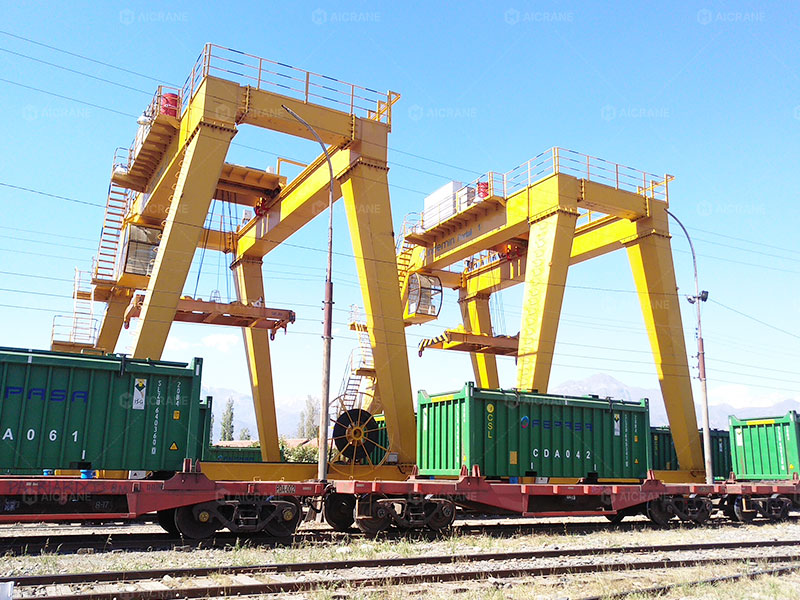
When Is a 50 Ton Gantry Crane Enough?
A 50 ton gantry crane can be appropriate when the maximum required lifted load is within the crane’s rated capacity and the project does not require additional capacity for foreseeable load growth.
For example, consider a precast concrete yard where the heaviest product weighs approximately 42 tons. If the lifting equipment, spreader beam, hooks, slings, or other permanently suspended equipment are accounted for within the crane’s design load and the resulting lifting requirement remains within the specified capacity, a 50 ton crane may be suitable.
A 50 ton configuration may also make sense when:
- Most loads are substantially below 50 tons.
- The heaviest loads are infrequent.
- The load weights are accurately documented.
- The lifting accessories have been included in the engineering calculation.
- There is little expectation of handling heavier products later.
- The available foundation or ground conditions favor a lower equipment load.
- The project is sensitive to equipment and infrastructure costs.
The important point is that a 50 ton crane should not be selected simply because the heaviest object weighs less than 50 tons. The complete lifting arrangement must be evaluated.
When Should You Consider a 60 Ton Gantry Crane?
A 60 ton gantry crane becomes more relevant when the required lifting capacity is close to 50 tons or when future operating requirements are uncertain.
For example, suppose a fabrication facility currently handles components weighing 47–48 tons but expects some future components to approach 55 tons. A 50 ton crane would not provide sufficient rated capacity for those future loads. A 60 ton crane may provide the required capacity, assuming the complete design meets the applicable engineering and operating requirements.
A 60 ton crane may also be considered when:
- Loads frequently approach the 50 ton range.
- Heavy lifting accessories add meaningful weight.
- Future products may be heavier.
- The crane must handle a broader range of large components.
- The buyer wants to avoid replacing the crane when production requirements increase.
- The lifting application requires a greater rated capacity based on the engineered load case.
However, a higher capacity should not be treated as automatically better. The industrial gantry crane still needs to match the actual application.
How Should You Calculate the Required Crane Capacity?
The first step is to establish the maximum gross lifted load, not simply the weight of the main product.
A practical calculation starts with:
Required lifting load = load being lifted + applicable lifting accessories
Depending on the configuration, accessories can include:
- Spreader beams
- Lifting beams
- Slings
- Shackles
- Lifting frames
- Special hooks or grabs
- Other permanently or temporarily suspended equipment
For example, if a component weighs 47 tons and the lifting arrangement adds 2 tons, the crane must be evaluated for a 49 ton lifted load rather than 47 tons.
This does not mean that a 50 ton crane should automatically be selected. Engineers also need to consider how the load is lifted, whether the crane is intended for single-load or tandem operations, the duty classification, environmental conditions, and applicable design requirements.
The capacity calculation should therefore be performed as part of the crane’s engineering design rather than as a simple comparison between product weight and nameplate capacity.
Why Is Operating Margin Important?
A crane should not normally be selected so that every routine lift is effectively at the absolute rated limit.
If a facility routinely handles loads very close to the crane’s rated capacity, operating requirements become less flexible. Load measurement uncertainty, accessory weights, changes in product design, and future production requirements can become important.
Consider two examples:
Application A:
Maximum gross lifted load is approximately 35 tons, with occasional loads around 45 tons.
A 50 ton crane may provide an appropriate capacity range if the complete engineering assessment supports it.
Application B:
Maximum gross lifted load is regularly 48–50 tons, with occasional requirements that could reach 55 tons.
A 60 ton crane may be more appropriate because the required operating envelope extends beyond the practical capability of a 50 ton crane.
The objective is not to maximize the capacity. It is to ensure that the selected crane covers the actual design load envelope.
Does a 60 Ton Crane Require a Heavier Structure?
Potentially, yes.
The difference between 50 and 60 tons can affect the structural and mechanical design of the entire gantry crane. However, the actual difference depends on the crane’s span, lifting height, duty class, wheel arrangement, design standard, and other specifications.
For example, a 60 ton crane with a relatively short span and moderate lifting height may have very different structural requirements from a 60 ton crane with a long span and high lifting height.
Important variables include:
Span
A longer span can increase structural demands on the main girder and supporting structure.
Lifting Height
Greater lifting height can affect the hoist, rope system, drum, trolley arrangement, and overall crane dimensions.
Duty Classification
A crane that performs frequent lifting cycles may require different mechanical and structural design from a crane that performs only occasional heavy lifts.
Travel Conditions
Wheel loads and travel forces depend on the crane configuration, total crane weight, load, wheel arrangement, travel acceleration, and other design parameters.
Therefore, capacity should always be evaluated together with span, lift height, duty, and operating conditions.
How Does Capacity Affect Ground and Foundation Requirements?
For outdoor gantry cranes, the ground and foundation design can be just as important as the crane itself.
A heavier or higher-capacity crane can result in different wheel loads and structural reactions. The supporting system must be designed for the actual crane configuration.
Buyers should provide the gantry crane manufacturer with information such as:
- Ground or foundation type
- Rail arrangement, if applicable
- Rail gauge
- Span
- Crane capacity
- Maximum lifted load
- Operating frequency
- Outdoor or indoor operation
- Wind conditions for outdoor cranes
- Required travel speed
- Site conditions
For rail mounted gantry cranes, foundation and rail design should be coordinated with the crane’s maximum wheel loads and applicable structural requirements.
A 60 ton crane should therefore not be evaluated only by comparing its purchase price with that of a 50 ton crane. Any changes to the supporting infrastructure should also be considered.
What About Hoist and Trolley Selection?
The hoisting system must match the crane’s rated capacity and operating requirements.
For a 50 ton or 60 ton gantry crane, buyers may encounter configurations such as:
- Single hoist
- Main and auxiliary hoist
- Single trolley
- Dual lifting mechanisms
- Special lifting beams
- Synchronized lifting systems
The correct arrangement depends on the loads being handled.
For example, a long steel structure may require a different lifting arrangement from a compact precast concrete component even if both have similar weights.
If the project involves lifting large or flexible loads, the engineer should consider load geometry, lifting points, center of gravity, and load stability rather than selecting the crane based on capacity alone.
50 Ton vs 60 Ton Gantry Crane for Different Applications
The appropriate capacity can vary significantly by industry.
Precast Concrete
Precast plants often handle beams, bridge components, panels, molds, and other large concrete products.
If the heaviest finished product is consistently below 50 tons, a 50 ton crane may be sufficient. If production plans include heavier bridge girders or larger precast elements, a 60 ton configuration may provide the necessary capacity.
Steel Fabrication
Steel fabrication facilities may handle plates, structural assemblies, vessels, modules, and fabricated components.
The key question is not simply the weight of individual steel plates but the weight of the largest assembled component that must be lifted.
Shipbuilding and Marine Projects
Marine fabrication can involve very large assemblies with changing dimensions and centers of gravity. In these applications, capacity should be evaluated together with lifting geometry, working radius or position, load stability, and site layout.
Machinery Manufacturing
Machinery manufacturers may handle heavy equipment frames, industrial machines, engines, or assembled components.
If product weights vary considerably, historical production data can help determine whether 50 tons covers the required range or whether 60 tons is justified.
Should You Choose 60 Tons for Future Expansion?
Future capacity is worth considering, but buyers should avoid paying for capacity that will never be used.
A useful approach is to examine the company’s expected production over the intended crane service period.
Ask:
- What is the heaviest load today?
- What is the heaviest load expected within the next several years?
- Are product sizes increasing?
- Will new manufacturing lines be added?
- Could lifting accessories become heavier?
- Could the crane be moved to another production area later?
- Would replacing the crane be significantly more expensive than selecting a higher capacity initially?
If future requirements could realistically exceed 50 tons, a 60 ton crane may need to be considered during the initial project design.
If future expansion is speculative and the facility has no foreseeable need for loads above 50 tons, selecting a larger crane simply for additional nominal capacity may not be economically justified.
Does a 60 Ton Gantry Crane Cost More?
Generally, a higher-capacity gantry crane can require additional equipment and structural capacity, which can affect the overall project cost. However, capacity alone does not determine the final price.
Other major cost factors include:
- Crane span
- Lifting height
- Duty classification
- Hoisting speed
- Crane travel speed
- Trolley configuration
- Control system
- Power supply
- Outdoor protection requirements
- Wind protection
- Rail and foundation requirements
- Installation conditions
- Testing and commissioning requirements
For this reason, a 50 ton crane with a long span, high lift, and heavy-duty operating cycle could potentially have very different costs from a compact 60 ton crane.
When requesting quotations, buyers should provide a complete technical specification rather than asking only for a “50 ton” or “60 ton” crane price.
A Practical Selection Checklist
Before deciding between a 50 ton and 60 ton gantry crane, collect the following information:
Load Requirements
- Maximum product weight
- Maximum gross lifted weight
- Lifting accessory weight
- Load dimensions
- Center of gravity
- Lifting points
Crane Dimensions
- Required span
- Required lifting height
- Required hook travel
- Crane runway or travel distance
Operating Requirements
- Lifts per hour or shift
- Working hours per day
- Expected annual operating frequency
- Required hoisting and travel speeds
- Indoor or outdoor operation
Site Conditions
- Ground or foundation conditions
- Rail requirements
- Wind exposure
- Temperature range
- Available power supply
Future Requirements
- Expected increase in product weight
- Planned production expansion
- Potential changes in crane location
- Expected service period
This information allows the manufacturer or engineering team to determine whether 50 tons, 60 tons, or another capacity is appropriate.
50 Ton or 60 Ton: Which Should You Select?
The answer depends on the project’s actual load envelope.
A 50 ton gantry crane is generally worth evaluating when the maximum gross lifted load remains within 50 tons, operating requirements are well defined, and future loads are not expected to exceed that range.
A 60 ton gantry crane should be evaluated when the required gross lifted load approaches or exceeds 50 tons, when future loads may reach approximately 60 tons, or when the project requires additional rated capacity based on its engineered lifting requirements.
The decision should be made using the complete gantry crane specification – not capacity alone. Span, lifting height, duty class, lifting configuration, operating environment, wheel loads, foundation requirements, and future production plans can all change the appropriate configuration.
Key Takeaways
- 50 tons vs 60 tons represents a 10 ton, or 20%, difference in rated capacity.
- Select capacity based on the maximum gross lifted load, including applicable lifting accessories.
- A 50 ton crane may be suitable when the required load envelope remains comfortably within its rated capacity.
- A 60 ton crane should be considered when loads approach 50 tons or future requirements may exceed 50 tons.
- Crane capacity also affects structural, mechanical, travel, and supporting-system requirements.
- Span, lifting height, duty classification, operating frequency, and site conditions can be as important as rated capacity.
- Do not select a larger crane solely because it has a higher capacity; evaluate the additional equipment and infrastructure requirements.
- For purchasing decisions, provide the manufacturer with the complete load, dimensional, operating, and site requirements rather than requesting a quotation based only on tonnage.