As infrastructure construction moves toward industrialization and modularity, the utilization of precast concrete elements across bridges, railways, tunnels, and marine structures continues to expand. Precast components are characterized by large dimensions, substantial dead weight, and complex geometry, imposing specific operational demands on material handling and yard logistics. Straddle carrier cranes – mobile lifting equipment equipped with self-propulsion, multi-mode steering, and the ability to travel over stacked materials – are widely deployed in heavy precast concrete logistics. This article outlines the structural and operational features of straddle carrier cranes, examines their role across key workflow stages including stripping, curing, storage, vehicle loading, and site transfer, and reviews ongoing developments in electrification and automation.
1. Introduction: Handling Requirements in Precast Concrete Construction
Modern infrastructure projects increasingly rely on precast concrete components, such as box girders, T-beams, segmental bridge spans, shield tunnel segments, and heavy utility columns. The production and construction lifecycle of these components involves several critical material handling phases:
- Formwork Stripping and Curing Transfer: Once concrete achieves initial structural strength, components are stripped from molds and transferred to dedicated curing zones.
- Yard Storage Management: Casting yards require systematic, high-density storage and retrieval of heavy components within finite land areas.
- Outbound Dispatch and Loading: Heavy elements must be raised and positioned accurately onto flatbed trailers or specialized transport vehicles.
- On-Site Unloading and Handling: Construction sites often present tight space constraints and uneven ground conditions, requiring mobile lifting equipment.
Traditionally, yards have relied on rail mounted gantry cranes, crawler cranes, or mobile truck cranes. Rail-mounted gantry cranes are constrained by fixed rail paths and require capital-intensive civil foundation work. Mobile truck cranes require outrigger deployment, which consumes operational area and slows down frequent repositioning. Rubber-tyred straddle carrier cranes offer an alternative solution due to their portal frame structure, mobility, and independence from fixed rail infrastructure.
2. Technical Characteristics of Straddle Carrier Cranes
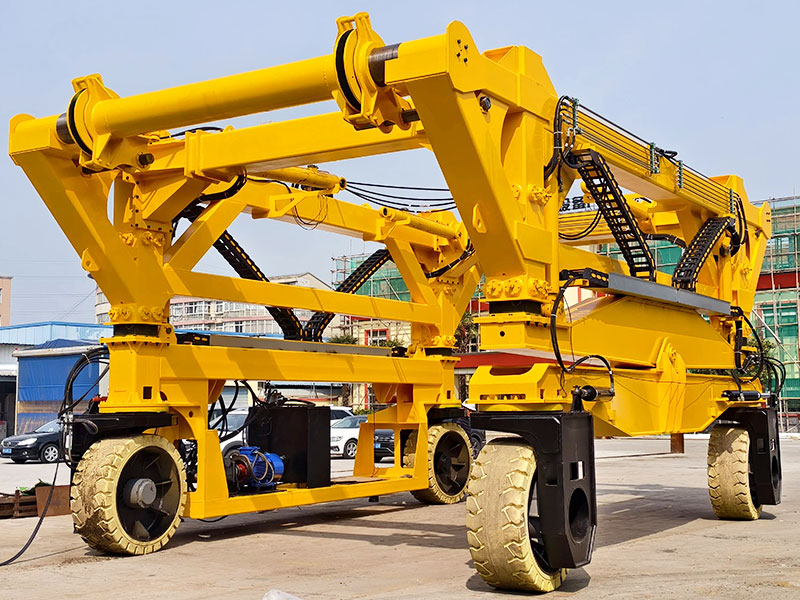
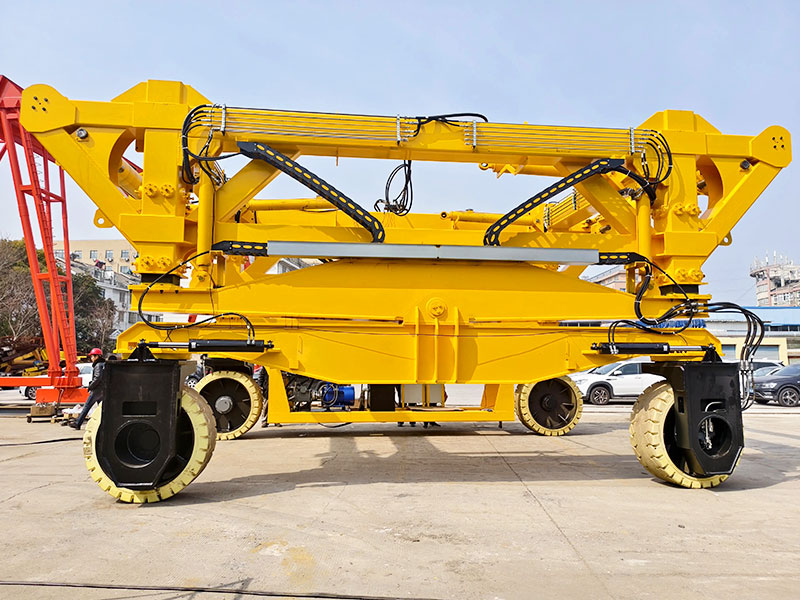
A straddle carrier crane is a self-propelled portal crane with an inverted U-shaped structural frame supported by multiple sets of heavy-duty rubber tires. The machine drives directly over components or stacked materials, using internal hoists to lift loads vertically and transport them within its framework.
Key structural and functional characteristics include:
2.1 Spatial Clearance and Stacking Capability
The interior dimensions of a straddle carrier crane can be customized according to component dimensions. The frame allows the machine to drive directly over existing storage stacks or traffic lanes to pick up or place components. This reduces the need for wide dedicated roadways or fixed track foundations, allowing higher land utilization in storage yards.
2.2 Multi-Mode Steering Systems
Heavy-duty straddle carrier cranes utilize hydraulic or electric independent wheel steering, supporting multiple travel configurations:
- Direct and Sideways Travel (90-Degree Crab Steering): Enables lateral movement across narrow corridors.
- Diagonal Travel: Assists in rapid alignment and vehicle positioning.
- Carousel / Concentric Turning: Minimizes turning radius for operation within tight spatial boundaries.
2.3 Rail-Free Mobility and Terrain Adaptability
Equipped with low-ground-pressure pneumatic or solid rubber tires, straddle carrier cranes operate on paved concrete, compacted gravel, or graded soil. They can negotiate mild inclines, typically between 3 percent and 5 percent. Because no steel rails or concrete foundation beams are needed, initial yard setup costs and site preparation requirements are reduced.
3. Optimization of Precast Concrete Handling Workflows
Precast concrete manufacturing and transport involve consecutive operational steps. The table below summarizes how straddle carrier cranes compare with conventional lifting equipment across primary stages:
| Handling Stage | Traditional Equipment Features (Rail Gantry / Truck Crane) | Straddle Carrier Crane Implementation |
|---|---|---|
| Stripping & Curing | Bound by fixed tracks or constrained by outrigger setup time | Straddles casting beds directly, lifting and moving elements without secondary transfer steps |
| Yard Storage | Requires wide clearance for outriggers or dedicated rail corridors | Enables high-density parallel stacking, reducing required aisle widths |
| Truck Loading | Outrigger positioning takes time; trucks must maneuver precisely | Straddle crane positions over trailer, lowering load from above |
| Handling Long Elements | Single-point or unequal lifting increases structural flexure risks | Employs multi-point synchronized hydraulic lifting to balance load distribution |
3.1 Increasing Storage Density
Land preparation and lease costs for precast yards can represent a significant portion of project overhead. Rail-mounted gantry cranes are restricted to the span between their tracks, leaving areas outside the rails underutilized.
Straddle carriers operate without fixed rails, allowing yard layouts to be adapted based on production demands. Because the crane travels over the stored components, travel aisles only need to accommodate the width of the tire wheelsets. Field data indicates that using straddle carriers can improve yard storage capacity per unit area compared to traditional setups.
3.2 Synchronized Lifting and Load Protection
During initial curing stages, concrete exhibits relatively low tensile strength, making components susceptible to micro-cracking if subjected to unequal lifting forces or torsional stress.
Large straddle carrier cranes are commonly configured with multi-point synchronized hydraulic hoisting and anti-sway control systems. When transporting long items such as box girders or bridge segments, the crane maintains balanced lifting points, mitigating flexural stresses caused by uneven tilting during movement.
3.3 Streamlining Trailer Loading Operations
In conventional truck-loading setups, flatbed trailers must execute precise reverse maneuvers under fixed gantry cranes. With a straddle carrier crane, the trailer remains parked in a designated lane while the crane carrying the component approaches from above and lowers the load directly onto the bed. This method reduces alignment duration and improves transport truck turnaround times.
4. Economic, Operational, and Safety Considerations
Beyond operational efficiency, straddle carrier cranes affect overall project costs and risk management:
4.1 Lower Infrastructure Expenditure and Equipment Relocation Costs
- Elimination of Rail Foundations: Laying steel tracks and constructing reinforced sub-bases for rail cranes involves substantial capital investment. Straddle carriers require only graded and compacted surfaces.
- Asset Mobility: At project completion, straddle carriers can be disassembled into modular units, transported to new construction sites, or driven short distances via road networks, supporting higher asset reusability.
4.2 Operating Stability and Hazard Control
- Low Center of Gravity: Loads are carried suspended within the machine frame rather than elevated on a long boom, maintaining a lower overall center of gravity. This enhances stability under wind loads compared to high-reach mobile gantry cranes.
- Operator Assist Systems: Modern units incorporate surround-view cameras, radar/LiDAR obstacle detection, and inclination sensors to assist operators in busy construction environments.
5. Primary Application Scenarios
Scenario 1: Highway and Railway Precast Yards
Highway and railway construction projects rely heavily on large precast box girders and T-beams. Heavy rubber-tyred straddle carriers manage the complete yard sequence—lifting girders from casting forms, moving them to curing beds, and feeding them onto transport vehicles or beam-launching gantries.
Scenario 2: Urban Elevated Expressways and Mass Transit Bridges
Urban construction sites are frequently constrained by land availability. Elevated roads and light-rail elevated lines often utilize precast segmental construction. Straddle carrier cranes operate effectively within narrow urban yards, handling, stacking, and loading complex segment shapes.
Scenario 3: Marine Caissons, Utility Tunnels, and Shield Segments
In port developments, underground utility corridors, and subway projects, large volumes of specialized concrete elements (such as tunnel lining segments and marine caissons) are produced. Straddle carriers equipped with custom spreaders facilitate repeatable handling, reducing manual rigging interventions.
6. Emerging Technological Trends: Electrification and Automation
Driven by environmental regulations and digital construction initiatives, straddle carrier cranes are evolving in several key technological areas:
- Electric and Hybrid Drivelines: Traditional diesel-powered systems are being replaced by hybrid or fully battery-electric power trains. Electric straddle carriers eliminate direct exhaust emissions, utilize regenerative braking to recover energy during load lowering, and reduce operational noise levels.
- Automated and Autonomous Operations: Integrating high-precision positioning (such as RTK-GPS), LiDAR, and computer vision enables semi-autonomous or fully autonomous navigation. In digitized precast plants, straddle carriers can execute pickup, transport, and stacking commands automatically via Manufacturing Execution Systems (MES) and Building Information Modeling (BIM) data.
- Digital Inventory and Asset Tracking: By integrating RFID tags, IoT sensors, and fleet management software, straddle carriers automatically update component locations in real time within yard management software, improving inventory traceability.
7. Conclusion
As infrastructure construction adopts industrialized precast methods, yard logistics plays a central role in maintaining project schedules and controlling operational costs.
Straddle carrier cranes offer flexible mobility, efficient yard spatial utilization, synchronized load distribution, and lower site infrastructure requirements. As electric drivelines and automated navigation technologies continue to mature, straddle carrier cranes will remain an important asset in precast concrete handling and infrastructure logistics.