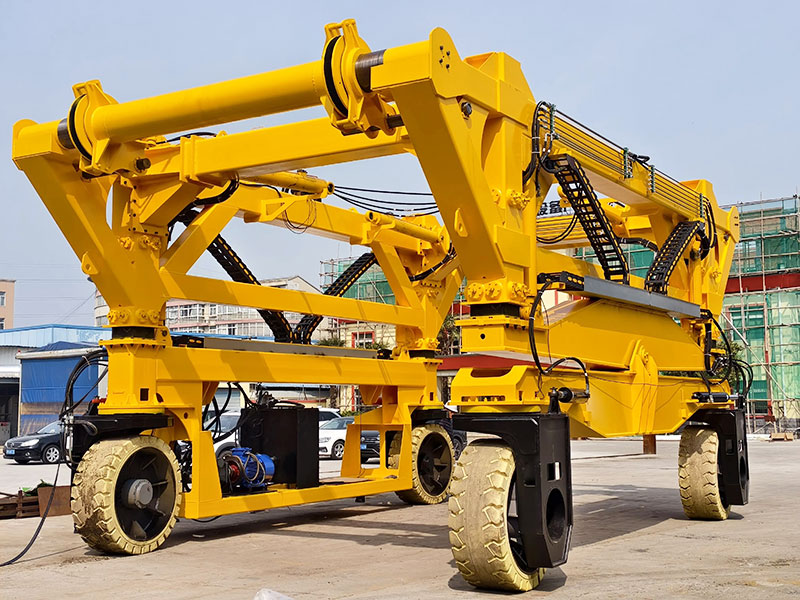
Choosing a straddle carrier for heavy precast concrete handling starts with the load, not the machine. The most important factors are the maximum load weight, load dimensions, lifting height, required travel distance, yard surface, handling frequency, and available power supply. A carrier designed for 40-ton precast elements, for example, may be unsuitable for a 70-ton bridge beam even if the beam can physically fit inside its frame.
For precast concrete plants and infrastructure projects, the right straddle carrier should match the complete handling cycle: lifting the precast element, transporting it through the yard, positioning it in storage, and retrieving it for dispatch or installation. Capacity, frame dimensions, steering configuration, lifting system, ground clearance, and control method all affect whether the equipment can perform this cycle safely and repeatedly.
1. Start With the Actual Weight of the Precast Concrete
The first specification to establish is the heaviest load that the straddle carrier for sale will handle, rather than the average load.
Precast products can vary significantly in weight. A yard may handle relatively small concrete panels during normal production but occasionally move bridge girders, large columns, tunnel segments, or other structural components that weigh several times more.
When determining required capacity, consider:
- Maximum individual precast component weight
- Lifting accessories and spreader beams
- Weight variations caused by different concrete designs
- Future products planned for the same yard
- Whether the carrier will lift from production lines, molds, storage areas, or transport trailers
For example, if the heaviest precast element weighs 45 tons and the lifting accessories add another 3 tons, selecting a carrier with a nominal capacity of exactly 48 tons leaves little practical margin.
A more useful approach is to define the maximum operational load, including the lifting attachment, and then discuss the appropriate safety and engineering margin with the equipment manufacturer.
For projects involving bridge girders or large structural components, the load chart should also be checked against the required lifting height and load position. Rated capacity should not be treated as a single number independent of operating conditions.
2. Check the Dimensions of the Precast Component
Weight alone does not determine whether a straddle carrier is suitable.
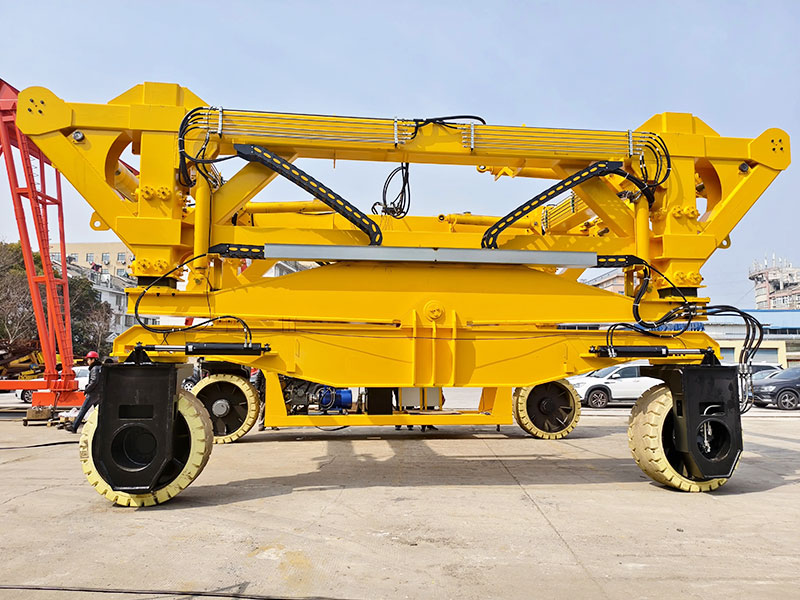
Large precast concrete products can be long, wide, or tall while remaining within the carrier’s rated weight capacity. The equipment therefore needs enough clearance between its legs and sufficient lifting geometry for the actual component.
Important dimensions include:
- Overall length
- Overall width
- Overall height
- Lifting points
- Center of gravity
- Required clearance from the carrier frame
- Required clearance between the load and the ground
- Required storage height
Consider a precast beam that weighs 50 tons but is 20 meters long. The carrier must accommodate the beam’s length and lifting configuration, not simply its 50-ton weight.
The center of gravity is particularly important for irregular precast components. If the lifting points are not positioned symmetrically, the load may not remain level during lifting. The carrier, spreader beam, and lifting accessories therefore need to be considered as one handling system.
3. Determine the Required Lifting Height
The required lifting height should be based on the highest point the load must clear, not simply the height of the storage stack.
For example, a mobile gantry crane may need to:
- Pick a precast element from a production mold.
- Lift it above nearby equipment.
- Travel through a designated lane.
- Place it on supports in the storage yard.
- Later retrieve it for loading onto a trailer.
Each operation may require a different clearance height.
A project that only requires low-level horizontal transportation may need much less lifting height than a precast yard that stacks components vertically.
When calculating lifting height, include the height of:
- The precast component
- Lifting hooks or chains
- Spreader beams
- Storage supports
- Trailer decks
- Other obstacles along the travel route
The practical requirement is not simply “lift 8 meters.” It may be “raise a 5-meter-high precast structure high enough to clear a 1-meter support system and surrounding obstacles.”
That distinction can significantly affect the required equipment configuration.
4. Match the Straddle Carrier to the Yard Layout
A straddle carrier works inside a defined operating area, so the yard layout directly affects equipment selection.
Before choosing the machine, map the typical route from production → temporary storage → final storage → dispatch.
Measure:
- Lane width
- Turning areas
- Distance between storage rows
- Entry and exit points
- Fixed structures
- Drainage channels
- Utility lines
- Building columns
- Loading areas
- Trailer access routes
A carrier may have sufficient lifting capacity but still be impractical if it cannot maneuver between storage rows.
For example, a precast yard with narrow storage lanes may require a different steering arrangement from a large open yard where the carrier can travel long distances in straight lines.
The turning radius and steering modes should therefore be evaluated together with the site’s actual traffic pattern.
5. Evaluate Steering Requirements
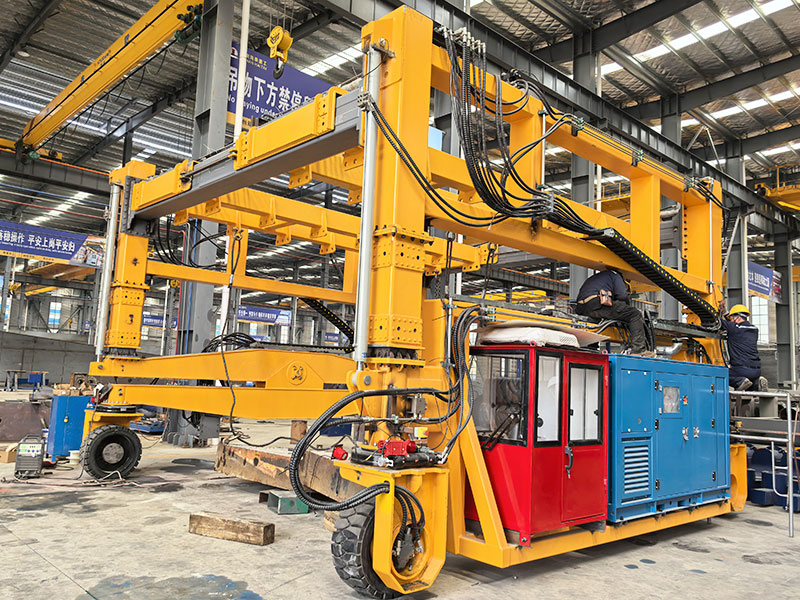
Steering becomes particularly important when handling large precast concrete components.
A rubber tire crane may need to travel straight, change direction at intersections, or position a long beam precisely between storage supports.
Common steering requirements can include:
- Straight travel
- Crab steering
- Pivot turning
- Diagonal movement
- Multi-mode steering for confined areas
For a long precast beam, lateral positioning can sometimes be more important than maximum travel speed. The carrier needs to align the load with storage supports or a trailer without repeatedly repositioning the entire machine.
If the yard includes narrow passages or multiple storage blocks, steering flexibility should be evaluated during the equipment-selection stage rather than after installation.
6. Consider the Ground Conditions
Heavy precast handling places substantial loads on the yard surface.
Before selecting a straddle carrier, assess:
- Concrete strength
- Asphalt condition
- Ground flatness
- Maximum allowable surface pressure
- Drainage
- Expansion joints
- Uneven sections
- Slopes
- Temporary construction areas
For heavy loads, the combined weight of the carrier and precast component can be much greater than the rated payload alone.
For example, a 60-ton precast element does not create a 60-ton operating load on the yard. The total system includes the carrier’s own weight and the dynamic effects associated with starting, stopping, steering, and uneven ground.
The wheel configuration and tire dimensions should therefore be evaluated against the site’s allowable ground pressure.
For newly planned precast yards, it is useful to coordinate the carrier specification and civil engineering design early. This allows the travel lanes, turning areas, and pavement structure to be considered together.
7. Compare Power Options With the Actual Yard Environment
Power configuration affects where and how the straddle carrier can operate.
Depending on the project, possible power arrangements include:
- Diesel generator power
- Cable reel power
- Battery-electric power
- Other site-specific electric configurations
A fixed production yard with an established electrical infrastructure may have different requirements from a construction project where the carrier needs to move between several work areas.
Battery-powered equipment can be useful where local operating requirements prioritize reduced onsite emissions and lower noise. Diesel-powered configurations can provide greater independence from fixed electrical infrastructure.
The key question is not simply which power source is better. It is:
What power source can reliably support the required lifting, travel, duty cycle, and operating environment?
The daily operating hours, charging or refueling arrangements, travel distance, and availability of electrical infrastructure should all be included in the calculation.
8. Match Travel Speed to the Handling Cycle
Maximum travel speed is only one part of productivity.
For a precast yard, the complete handling cycle includes:
pickup → lifting → acceleration → loaded travel → positioning → lowering → unloading → return travel
If a carrier travels quickly but requires significant time for positioning, the theoretical maximum speed will not determine actual throughput.
Suppose a carrier moves a precast component 150 meters from the production area to storage. Increasing travel speed may reduce transport time, but the total cycle can still be dominated by lifting, alignment, and positioning.
For this reason, evaluate:
- Loaded travel speed
- Unloaded travel speed
- Acceleration
- Braking
- Steering response
- Positioning accuracy
- Lifting and lowering speed
A balanced handling cycle is generally more useful than selecting equipment based only on the highest advertised travel speed.
9. Check the Required Duty Cycle
Precast plants can operate on very different production schedules.
A small facility may move several heavy components per day, while a high-volume precast operation may require continuous internal transportation.
The carrier’s duty cycle should therefore reflect:
- Lifts per hour
- Operating hours per shift
- Number of shifts per day
- Average travel distance
- Percentage of loaded versus unloaded travel
- Average load weight
- Peak load frequency
For example, a machine handling 20 heavy components per day has a different duty requirement from one handling 100 components per day.
The selection should be based on the actual operating cycle, not just maximum rated capacity.
10. Consider the Lifting and Load-Control System
Heavy precast components require controlled lifting and positioning.
The lifting system should be compatible with the project’s lifting points and accessories. Depending on the component, this can involve hooks, slings, spreader beams, or other engineered lifting arrangements.
Important considerations include:
- Number and position of lifting points
- Load leveling
- Vertical lifting accuracy
- Hoisting speed
- Lowering control
- Emergency stopping
- Load monitoring
- Operator visibility
For large concrete components, smooth acceleration and controlled stopping can be especially important because sudden movements can create unwanted load swing or impose additional forces on lifting accessories.
11. Consider Operator Visibility and Control
The operator needs to see both the carrier and the load path.
This becomes difficult when a large precast component blocks the forward field of view.
Possible solutions may include:
- Elevated operator cabins
- Remote controls
- Cameras
- Load-position monitoring
- Warning systems
- Defined travel zones
The choice depends on the Aicrane carrier design and site layout.
A remote-control configuration, for example, may be useful when the operator needs a better view of the load and surrounding clearance rather than remaining inside a fixed cabin.
12. Use a Selection Example Instead of Choosing by Capacity Alone
Consider a precast yard with the following requirements:
- Maximum precast component: 60 tons
- Typical component weight: 35–50 tons
- Maximum component length: 18 meters
- Required lifting height: 8 meters
- Travel distance: 100–250 meters per handling cycle
- Concrete yard surface
- Multiple storage rows
- Eight operating hours per day
A reasonable equipment-selection process would be:
Step 1: Establish the required rated capacity from the 60-ton maximum load and lifting accessories.
Step 2: Verify that the carrier frame and lifting system accommodate the 18-meter component.
Step 3: Confirm that the lifting height provides sufficient clearance for the component, rigging, and storage supports.
Step 4: Measure the storage lanes and turning areas to determine the required steering configuration.
Step 5: Check wheel loads and ground pressure against the concrete pavement design.
Step 6: Calculate the expected handling cycle using loaded and unloaded travel speeds.
Step 7: Select the power system according to operating hours and site infrastructure.
Step 8: Verify the control, visibility, and safety systems for the actual load-handling process.
This approach produces a much more defensible equipment specification than simply searching for a “60-ton straddle carrier.”
13. A Practical Straddle Carrier Selection Checklist
Before requesting a quotation, prepare the following information:
| Selection Factor | Information to Prepare |
|---|---|
| Maximum load | Heaviest precast component |
| Average load | Typical operating weight |
| Load dimensions | Length × width × height |
| Lifting height | Maximum required hook/load elevation |
| Lifting points | Number, spacing, and configuration |
| Travel distance | Typical loaded and unloaded routes |
| Yard surface | Concrete, asphalt, compacted ground, etc. |
| Lane width | Narrowest operating section |
| Turning area | Available maneuvering space |
| Storage height | Maximum stacking/support height |
| Operating cycle | Lifts per hour or day |
| Working hours | Hours per shift and shifts per day |
| Power | Diesel, cable, battery, or other requirement |
| Control | Cabin, pendant, remote, or combination |
| Environment | Indoor/outdoor, temperature, dust, rain |
| Future loads | Planned increase in component size or weight |
The more complete this information is, the easier it is to determine whether a proposed straddle carrier is actually suitable for the project.
Conclusion
Choosing a straddle carrier for heavy precast concrete handling requires more than matching the machine’s rated tonnage to the weight of a concrete component. The equipment must fit the load dimensions, lifting height, yard layout, ground conditions, steering requirements, handling cycle, duty cycle, power supply, and control system.
For bridge beams, tunnel segments, precast panels, columns, girders, and other large concrete components, the most important selection process is to analyze the complete movement from pickup to storage and from storage to dispatch.
A well-defined specification should therefore answer seven basic questions:
- How heavy is the heaviest load?
- What are the maximum load dimensions?
- How high must the load be lifted?
- How far and through what route must it travel?
- What are the site’s ground and maneuvering conditions?
- How frequently will the carrier operate?
- What power and control configuration matches the site?
Once these requirements are established, the straddle carrier can be selected around the actual precast handling process rather than around a single capacity number. This results in a specification that is easier to evaluate, quote, and integrate into a precast concrete or infrastructure construction workflow.